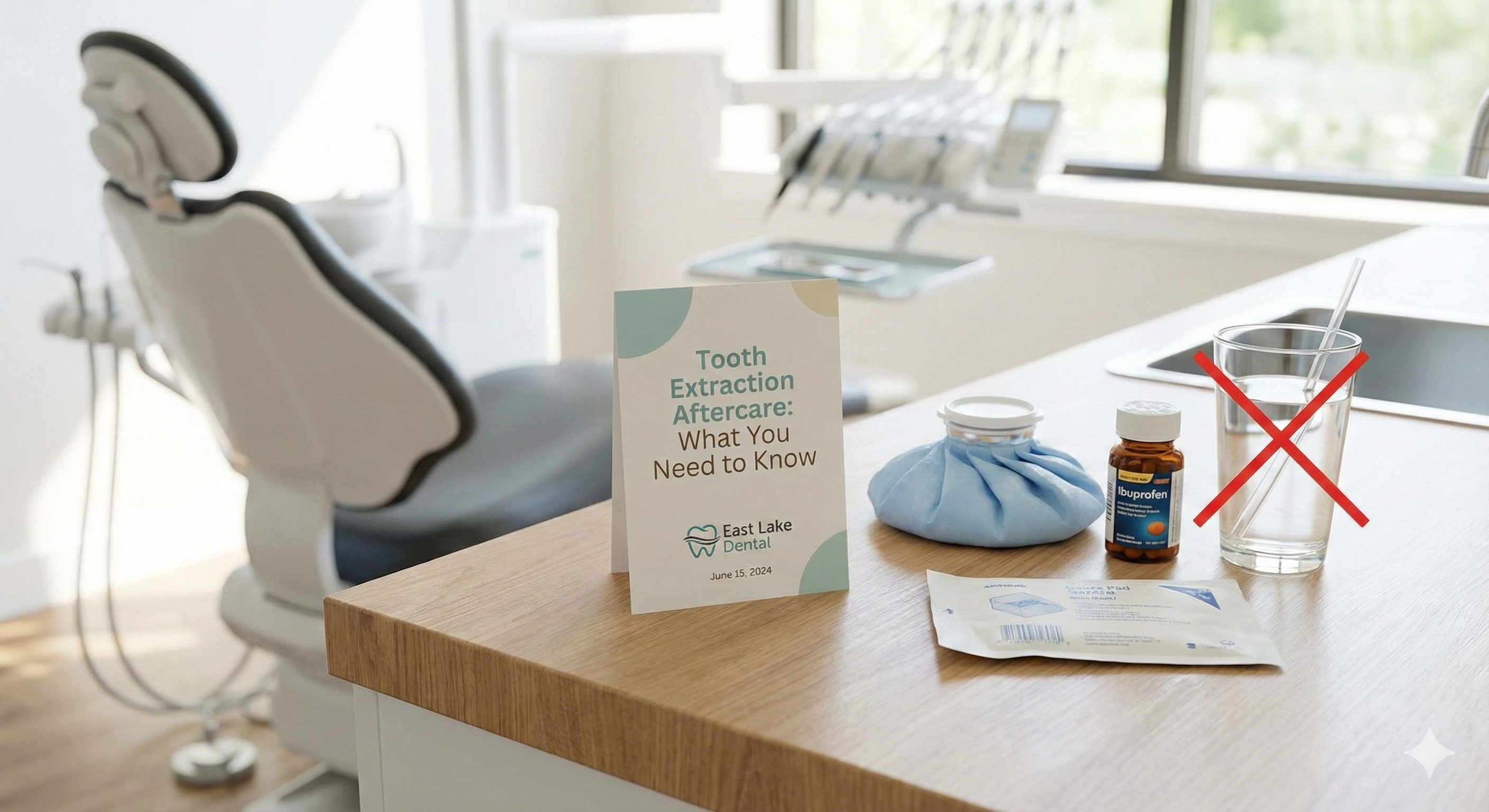
Most tooth extractions heal cleanly within a week or two. The complications that do come up almost always trace back to the same small list of mistakes in the first 72 hours: dislodging the blood clot, eating the wrong thing too soon, or missing the early signs of dry socket. This guide walks through recovery day-by-day so you know what is normal, what is not, and exactly when to call us.
If you are a current East Lake Dental patient and something feels off, you can always call us at (248) 437-4119. We would rather hear from you about something small than have you wait on something that turns out to matter.
The First 24 Hours: The Most Important Day
The single goal in the first 24 hours is to protect the blood clot that forms in the empty socket. That clot is the foundation for everything that heals after it. Lose it, and you risk dry socket, infection, and significantly delayed healing.
Hour 0 to Hour 2: Stop the Bleeding
- Bite firmly on the gauze pad for 30 to 45 minutes without checking it. Constantly peeking disturbs the clot that is trying to form.
- If bleeding continues after the first round, replace the gauze and repeat. A damp tea bag (regular black tea) is an excellent backup. The tannins help the clot form.
- Some oozing for the first several hours is normal. Bright red blood that fills your mouth quickly is not. Call us if heavy bleeding has not stopped after 2 hours of firm pressure.
- Do not talk, eat, or drink anything during the first hour. Keep your head elevated, even when resting.
Hour 2 to Hour 24: Protect the Clot
- No straws, no smoking, no spitting, no vigorous rinsing. All four of these create suction that can pull the clot out of the socket. This is the leading cause of dry socket.
- Apply an ice pack to the outside of your cheek in 20-minutes-on, 20-minutes-off cycles for the first 24 hours. This is the most effective swelling control there is.
- Eat cool or lukewarm soft foods only. More on that below.
- Sleep with your head slightly elevated on an extra pillow. It reduces overnight swelling and bleeding.
- You can brush the rest of your teeth normally, just steer clear of the extraction site itself.
Day-by-Day Recovery Timeline
Every mouth heals at a slightly different pace, but most simple extractions follow this general arc.
| Timeframe | What's Happening | What You Can Do |
|---|---|---|
| Day 1 | Clot is forming. Mild oozing, swelling peaks late in the day. | Rest. Ice on/off. Soft cool foods. No straws or smoking. |
| Day 2 to 3 | Swelling is at its worst. Mild to moderate ache, gradually improving. | Begin gentle warm salt water rinses (do not spit). Continue ice. Add slightly firmer soft foods. |
| Day 4 to 7 | Swelling drops sharply. Tissue starts closing over the socket. | Resume gentle brushing near the area. Most pain medication should no longer be needed. Avoid hard or crunchy foods. |
| Week 2 | Soft tissue largely healed. The socket may still look like a small divot. | Return to most normal eating. Be patient with anything crunchy or seedy until fully closed. |
| Month 1 to 6 | Underlying bone remodels. The socket fills in completely. | If you plan to replace the tooth, this is the window to start that conversation. Bone loss begins immediately. |
Wisdom tooth extractions and surgical extractions can extend each phase by a day or two and often involve more swelling and bruising on days 2 and 3. That is normal. The total recovery still follows the same general arc.
Dry Socket: How to Prevent It and Spot It Early
Dry socket (alveolar osteitis) is the most common complication after extraction, and it is also the most preventable. It happens when the blood clot dislodges or never properly forms, exposing the underlying bone and nerves.
What Dry Socket Feels Like
- Pain that was improving on day 1 and 2 suddenly gets sharper or starts throbbing on day 3 or 4.
- The pain often radiates from the socket toward your ear, temple, or jaw on the same side.
- You may notice a foul taste or bad breath that you cannot brush away.
- Looking in the mirror, the socket may appear empty, with whitish or grayish bone visible instead of a dark red clot.
How to Prevent It
- No suction for 72 hours. That means no straws, no smoking, no vaping, no spitting, and no swishing.
- No alcohol for 48 hours. Alcohol interferes with clotting and irritates the wound.
- No carbonated drinks for 24 to 48 hours. The bubbles can disturb the clot.
- Avoid seeds, nuts, popcorn, and crunchy foods for at least a week. Anything that can lodge in the socket should wait.
- If you take birth control or any blood thinner, mention it to your dentist before extraction. Both can affect clotting.
Dry socket is treatable. We pack the socket with a medicated dressing, and most patients feel relief within an hour. If you suspect it, do not tough it out. Call us at (248) 437-4119.
What to Eat After a Tooth Extraction
Food choices in the first three days do more for your recovery than almost anything else. Cool, soft, no chewing required.
Day 1: Cool and Soft Only
- Yogurt (any kind, just eat with a spoon)
- Applesauce
- Smoothies, but only eaten with a spoon. Never a straw.
- Lukewarm broth or thin soup (not hot)
- Mashed potatoes (not too hot, not too lumpy)
- Cottage cheese
- Ice cream, sorbet, or popsicles (a small reward, and the cold helps)
- Protein shakes
Days 2 to 3: Soft But Slightly Firmer
- Scrambled eggs
- Oatmeal (lukewarm, not hot)
- Soft pasta with mild sauce
- Pancakes or soft bread
- Well-cooked, soft vegetables like carrots or squash
- Soft tofu, soft fish, or finely shredded chicken
What to Avoid for at Least a Week
- Hot foods and drinks (heat dissolves the clot faster)
- Crunchy foods (chips, crackers, raw vegetables)
- Anything with seeds, grains, or small bits that can lodge in the socket (popcorn, sesame, quinoa, granola)
- Spicy food (irritates the wound)
- Sticky foods (caramel, taffy, gum)
- Alcohol for at least 48 hours
- Carbonated drinks for 24 to 48 hours
Managing Pain Without Overdoing It
Most extraction pain is well controlled with over-the-counter medication. The combination protocol below works as well as or better than prescription opioids for most patients, with none of the side effects.
- Ibuprofen (400 to 600 mg) every 6 hours, alternated with acetaminophen (500 to 1000 mg). Stagger them so you take something every 3 hours for the first 48 hours. Always follow the dosing on the bottle and do not exceed daily maximums.
- Ice on, ice off, 20 minutes each, for the first 24 hours. After day 2, warm moist compresses help residual stiffness.
- Take pain medication on a schedule, not just when pain spikes, for the first 24 to 48 hours. Staying ahead of pain is much easier than catching up to it.
- If your dentist prescribed antibiotics, finish the full course even if you feel better.
If OTC medication is not controlling your pain by the end of day 2, call us. That is not the medication's fault. It usually means something else is going on.
When to Call East Lake Dental
Call us at (248) 437-4119 the same day if any of the following happen:
- Heavy bleeding that does not stop after 2 hours of firm gauze pressure.
- Sudden sharp or throbbing pain on day 3 or 4, especially if it radiates to your ear. This is the classic dry socket signal.
- Severe pain that ibuprofen and acetaminophen will not touch.
- Swelling that gets worse instead of better after day 3, or hot, hard, red swelling that suggests infection.
- Fever over 101 degrees Fahrenheit or chills.
- Pus, drainage, or a foul taste that does not go away with rinsing.
- Numbness in your lip, chin, or tongue that has not resolved 24 hours after the procedure.
- Any reaction to medication (rash, hives, swelling of the face or throat, trouble breathing). For trouble breathing, call 911 first.
If you are not sure whether what you are feeling is normal, just call. Five minutes on the phone is always worth it.
Thinking About Replacing the Tooth
Once you are healed, the next decision is whether to replace the missing tooth. Doing nothing is an option, but the jawbone underneath an empty socket starts shrinking within months, neighboring teeth can shift into the gap, and bite forces redistribute across remaining teeth. Most patients eventually replace the tooth either way.
The three options patients ask about most:
- Dental implant: The closest match to a natural tooth. See our guide to dental implant costs in Michigan for pricing, insurance coverage, and timing.
- Bridge: A fixed restoration anchored to the two adjacent teeth. Faster and lower upfront cost than an implant, but the adjacent healthy teeth have to be filed down.
- Partial denture: Removable. Lowest upfront cost, but less stable and accelerates bone loss in the area.
If you are in South Lyon and want to talk through replacement options, schedule a consultation. We will look at the socket, your overall bite, and your budget, and walk through every option without pressure.
Related Reading
- Broken tooth or dental emergency? What to do first
- Dental implant cost in Michigan: 2026 pricing guide
- Signs of gum disease and how to prevent it
Questions About Your Dental Health?
We're here to help. Schedule an appointment or give us a call.
Request an Appointment