You are missing one tooth. Your dentist has given you two options and two prices, and the implant costs more. So you are trying to work out whether the more expensive thing is actually the better buy.
Fair question. Here is the ten-year math, which is the honest way to look at it.
What each one actually is
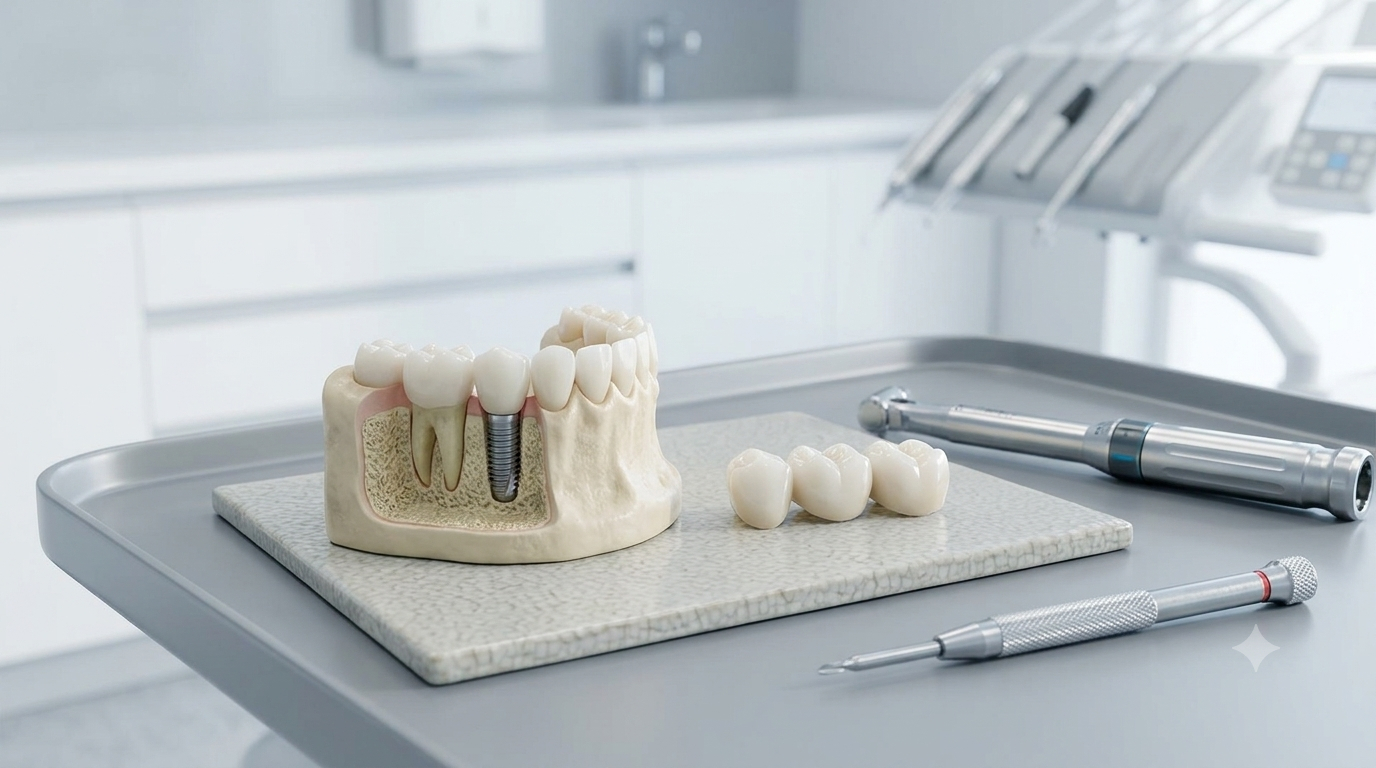
A bridge replaces the missing tooth by anchoring a false tooth to the teeth on either side of the gap. Those two neighbors get shaped down and capped with crowns, and the whole three-unit piece is cemented in as one. Usually two appointments, a few weeks apart. No surgery.
An implant is a titanium post placed into the jawbone where the root used to be, topped with an abutment and a crown. It does not touch the teeth beside it. It takes longer, because the bone has to heal around the post before the final crown goes on.
The upfront prices in Michigan
Single tooth implant: $5,000 to $6,000 for the complete procedure. That is the implant, the abutment, and the crown together.
Traditional bridge: $4,500 to $5,500 for a three-unit bridge.
Both numbers move with your specific case. Bone grafting, if you need it, runs $300 to $3,000 and applies to the implant side only.
The part that changes the answer
An implant is designed to be permanent. The post fuses to the bone and, barring an injury or a gum problem, it stays. The crown on top can wear out and get replaced, but the implant itself is a one-time cost.
A bridge is not permanent. A well-made bridge usually serves five to fifteen years, and that spread is the whole reason this comparison is worth doing. At the long end, your bridge is still going strong at year ten and the lower upfront price holds up. At the short end, you are buying a second one before the decade is out. When a bridge reaches the end of its life the whole three-unit piece comes off and gets remade, and that second bill belongs in today's decision rather than in a surprise years from now.
There are two other things that do not show up on the price sheet:
The two healthy neighbors. To place a bridge, we permanently reshape the teeth on either side of the gap. They were fine. Now they are crowned for life. If either one later needs a root canal or fails, you are not replacing one unit, you are rebuilding the whole span.
The bone underneath. A tooth root keeps the jawbone around it working. Remove the root and leave nothing in its place, and the bone in that spot gradually thins. An implant sits in the bone and keeps it loaded. A bridge spans over the top of the gap and the bone underneath does not get that signal.
Who actually does the work
Worth asking any practice this, so here is our answer. The surgical placement of the implant is done by a specialist we refer you to. The abutment and the crown, the part you see and bite with, are done here. That is a common arrangement and a deliberate one. A surgeon does the surgery, and the restorative work stays with the dentist who knows your mouth. You will know exactly who is doing which part before anything starts.
So which one
A bridge makes sense if the neighboring teeth already need crowns anyway, so nothing healthy is being sacrificed. Or if you cannot have surgery. Or if you need this resolved in weeks rather than months. Or if the upfront number is the deciding constraint, which is a legitimate reason and not one anybody should talk you out of.
An implant makes sense if the teeth on either side are healthy and you would rather not touch them. Or if you are planning to keep this tooth replaced for the next thirty years. Or if you want the option that is closest to what was there before.
What insurance does with each
Both usually land in your plan's least generous category, and both are affected by your yearly maximum. Some plans still classify implants as cosmetic and pay nothing toward them, while paying toward a bridge for the same missing tooth. That single line in your plan can make a bridge the better financial choice even when an implant is the better clinical one.
We will look up your specific plan before you decide anything. See how dental insurance actually works.
Before you choose
Come in and let us look. What decides this in practice is your bone density where the tooth is missing, the condition of the two teeth beside the gap, your bite, and your budget. Nobody can tell you which one is right from an article.
Call (248) 437-4119 and we will give you both numbers for your actual mouth.
Ready to See Both Numbers for Your Mouth?
Call (248) 437-4119 and we will give you implant and bridge estimates that match your actual case.
Request an Appointment